
TravelingForMiles.com may receive commission from card issuers. Some or all of the card offers that appear on TravelingForMiles.com are from advertisers and may impact how and where card products appear on the site. TravelingForMiles.com does not include all card companies or all available card offers.
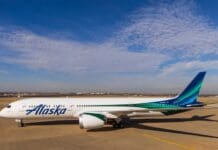
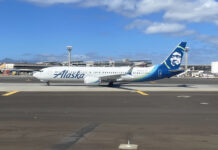
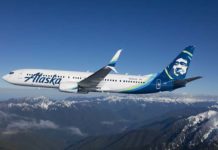
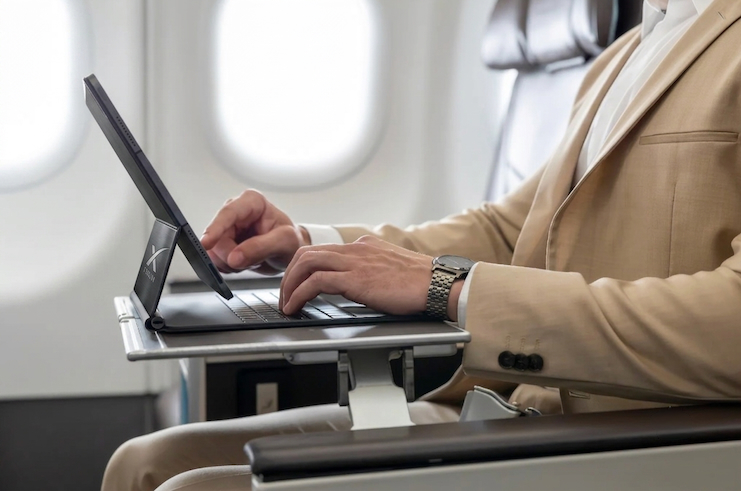
Late last week, Alaska Airlines and Hawaiian Airlines announced that roughly 150 aircraft, 38% of their combined fleet, are now equipped with Starlink Wi-Fi, putting the rollout ahead of schedule. Alaska is also now running a public rollout tracker, updated every four weeks, so flyers can follow progress by aircraft type as it happens.
The details
The Starlink rollout has reached 100% of Alaska’s regional fleet (the Embraer 175s) and the first 50 of its mainline aircraft. Hawaiian aircraft flying to and from North America, as well as on its international routes, are also equipped. Hawaiian’s inter-island flights don’t have Wi-Fi onboard at all.
As of 25 June, the tracker puts the fleet-wide figure at 38% of aircraft equipped.
The breakdown by aircraft type shows the regional Embraer 175 fleet (90 aircraft) and the Airbus A321neo fleet (18 aircraft) both fully converted, alongside 24 of Hawaiian’s Airbus A330s.
Installations have started on the Alaska Airlines Boeing 737-8 MAX fleet (10 done, 19 to go) but work has yet to start on the airline’s Boeing 787-9 Dreamliners, its Boeing 737-800s, it’s Boeing 737-900ERs and its Boeing 737-9 MAX aircraft. That’s well over 200 aircraft sitting in the queue.
Alaska says that it expects to have the whole of its fleet equipped with Starlink “by 2027” (it’s unclear if that means by the time 2027 comes around or by some point in 2027) and it seems to be making a big point of saying that it expects to finish equipping its widebody fleet “by this fall”.
What’s a little odd about that is that with all of its A330s now equipped with Starlink, that only leaves the airline with 5 widebody aircraft that don’t yet have the new technology (the 787-9s) and with fall still a few months away, that seems like a long time to fit out 5 aircraft.
Anyway, in further news, we’re told that a new onboard sign-in portal is being introduced to manage access to the free Wi-Fi, and it requires users to be Atmos Rewards members. This portal is already rolling out this month and it is expected to be standard across all flights by mid-July. Enrollment is free, and guests under 18 can connect simply by entering their reservation details without needing their own account.
The T-Mobile side of things
T-mobile seems to get a lot of mentions in the press release Alaska Airlines put out about its Starlink roll out but its role here looks, in effect, like sponsorship.
It’s named as Alaska’s presenting partner for the free Wi-Fi benefit, and the free access being offered to all Atmos Rewards members is described as made possible thanks to T-Mobile, rather than something Alaska is funding and delivering alone.
The companies frame this as building on a longer relationship: T-Mobile has powered free inflight Wi-Fi for its own customers on Alaska flights since 2014, and separately provides the connectivity tools Alaska’s flight attendants, pilots, and ground crews use to operate the airline.
On top of the free Wi-Fi everyone gets, T-Mobile customers who are also Atmos Rewards members get an additional perk: a seamless, ad-free sign-on experience, skipping the login steps other guests have to go through.
At the time of the original announcement (back in August last year), T-Mobile suggested that further exclusive perks for its customers would be announced later, although nothing further on that front has appeared in the latest update.
Final thoughts
The pace of this rollout is genuinely impressive, but the aircraft-level breakdown also shows there’s a lot of ground still to cover. The regional fleet and a couple of smaller widebody and narrowbody types are essentially done, but the bulk of Alaska’s actual mainline workhorses, the Boeing 737-800, 737-900ER, and 737-9 MAX fleets, well over 200 aircraft between them, haven’t started yet, so let’s wait and see how long it takes for those aircraft to have the new Wi-Fi systems fitted.
Bottom line
Alaska and Hawaiian have equipped 38% of their combined fleet, roughly 150 aircraft, with Starlink Wi-Fi, with the regional fleet fully converted and widebody completion expected this fall. The bulk of the mainline 737 fleet is still to come.
So far, this seems to be a fast, well-executed rollout, with T-Mobile effectively sponsoring the free access and throwing in a small ad-free log-on perk for its own customers on top (as a T-Mobile customer myself, I like that!), but let’s wait and how the rest of the rollout across the mainline fleet goes before we get too excited, because there’s still over 200 aircraft to go.