
TravelingForMiles.com may receive commission from card issuers. Some or all of the card offers that appear on TravelingForMiles.com are from advertisers and may impact how and where card products appear on the site. TravelingForMiles.com does not include all card companies or all available card offers.
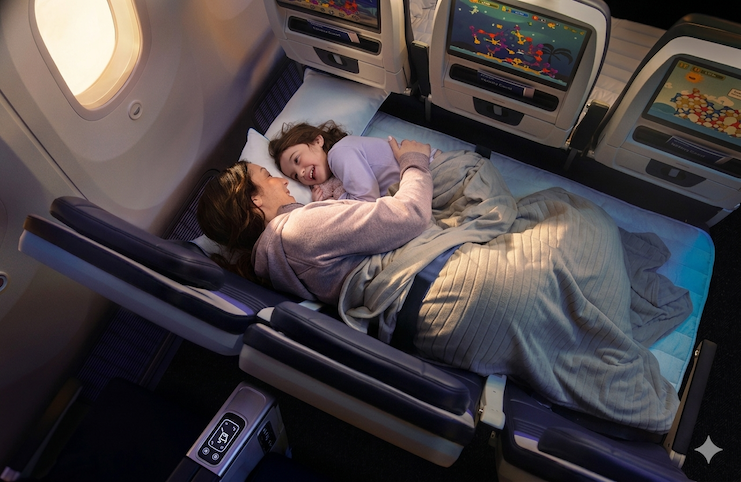
Yesterday, 24 March 2026, United Airlines caught a lot of us by surprise with a rather unexpected move in the world of Economy Class travel. At a media event held at a Los Angeles hangar, the airline announced the introduction of “United Relax Row,” a product that effectively turns a row of three Economy seats into a lie-flat surface.
If this sounds familiar, it’s because it is. United has secured the North American exclusivity rights for a design pioneered by Air New Zealand over a decade ago with its “Skycouch.”
For those of us who spend a significant amount of time crossing the Atlantic or Pacific in the back of the bus, any innovation that doesn’t involve further seat-pitch “optimization” (read: shrinkage) is usually worth a closer look.
What is the United Relax Row?
The concept is relatively straightforward.
The Relax Row consists of three standard Economy seats equipped with specially designed leg rests. After take-off, these leg rests can be raised to a 90-degree angle, meeting the seat cushion to create a wider, flat surface.
The United Airlines press release didn’t offer up any dimensions (not particularly helpful), but given that United’s Economy Class seat dimensions aren’t too dissimilar to the dimensions of the seats offered by Air New Zealand, it’s probably safe to assume that with the armrests raised and the leg rests extended, you’ll get a platform which is approximately 5’1″ long (~155cm) and 29″ (~74cm) wide.
It’s not exactly a Polaris suite, but for a solo traveler or a someone with a small child, it offers a way to lie down that simply doesn’t exist in standard economy class on most other airlines.
United has confirmed that passengers who book the Relax Row will receive a dedicated amenity kit to help make the “couch” a bit more comfortable.
This includes:
- A custom-fitted mattress pad.
- A specially sized plush blanket.
- Two additional pillows.
- A children’s travel kit (including a plush toy) for families.
The airline plans to roll this out starting in 2027, with the goal of equipping over 200 Boeing 787 Dreamliners and 777 aircraft by 2030.
Each aircraft is expected to feature up to 12 of these sections, typically located in the first few rows of the Economy cabin, immediately behind Premium Plus.
United Relax Row vs Air New Zealand Skycouch
Since United is using the Air New Zealand design, the physical product is likely to be near-identical, but the comparison becomes interesting when it comes to in-seat safety.
Air New Zealand provides a specialized seat belt that allows passengers to stay buckled while lying down, even during turbulence (the “cuddle belt”), but while United has mentioned “specially sized blankets” and special “safety features,” in its description of the new “Relax Row”, it remains to be seen if its safety protocols for lying flat in Economy will be as seamless as Air New Zealand’s original.
Cost and how you book
United hasn’t released specific pricing yet, but we can look at the Air New Zealand model for a hint.
On Air New Zealand, you don’t just book a Skycouch. You book the three seats and pay a varying surcharge depending on how many people are in your party.
If you are a solo traveler wanting the whole row, to yourself, the surcharge is high. If your party is made up of two people, the surcharge is lower because you’ve already paid for two out of the three seats.
United’s Chief Commercial Officer, Andrew Nocella, indicated that the price point will sit somewhere between standard Economy and Premium Plus (obviously!) but that’s all we know right now.
Is it actually comfortable?
We should be realistic here. This is still Economy Class, but it definitely beats a standard seat.
At an estimated 5’1″ in length (~155cm), most adults will not be able to stretch out fully without curling their legs. If you are 6 feet/183cm tall, this isn’t a bed. It’s a padded shelf for your lower half while you lean against the window or try to make more space by lying diagonally (where you may be able to get up to 170cm of space).
At an estimated 29 inches (~74cm) wide, it’s a lot wider than a standard seat, but it’s still narrow for two adults to share comfortably for a long nap. Some sort of “spooning” will be required and it will probably be tight.
While the mattress pad helps make things a little more comfortable, the fact remains that you are still lying on top of seat belt buckles and the gaps/bumps between three individual seat cushions, so no one should be expecting a Four Seasons bed.
Having said that, for a parent traveling with a child, the Relax Row could be a game-changer. It creates somewhere for the child to sleep in a more natural position, and it can provide a play area, all of which can make a flight significantly less stressful for the parent(s) and possibly even the passengers sitting nearby.
Final thoughts
Let’s give United some credit here. It’s refreshing to see a US airline unveil an Economy Class idea that doesn’t add extra limits on the space each passenger has and that isn’t just a new way to charge for snacks or “preferred” seating.
United is clearly aiming for the family market and the “value-conscious” solo traveler who can’t justify a Business Class or Premium Economy fare, but who also can’t face 9+ hours in a standard upright seat that offers minimal legroom or lateral space.
The rollout date is still almost year away (possibly more), and a lot can change in the industry (and the economy) before then, but for now, let’s look forward to United providing flyers with an option that, up until now, has only been available on Air New Zealand and on a very small subset of the Air Nippon Airways (ANA) fleet.
Whether the “Relax Row” actually leads to relaxation or just a slightly more expensive way to be cramped remains to be seen, but the option is a welcome addition and it will be interesting to see how (if) the likes of American Airlines and Delta react given that United has North American exclusivity rights over this product.